Weather Explained
Why does radar show rain when the ground is dry?
Radar samples the atmosphere above the ground. Learn how evaporation, beam height, and timing can explain a dry gauge under an echo.
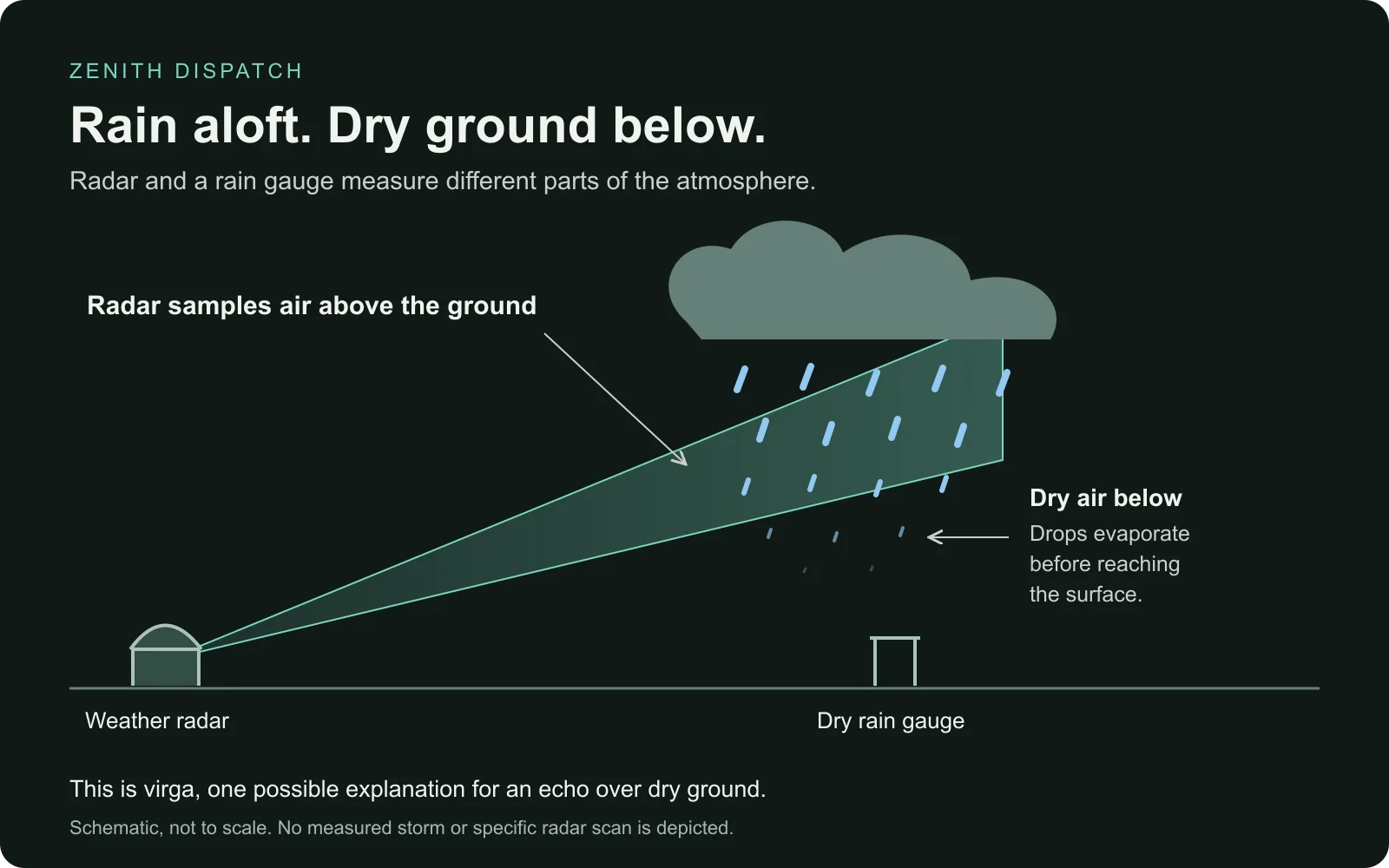
Diagram: Radar can detect falling rain above a dry surface. Here, the drops evaporate below the sampled air. This schematic illustrates virga, one possible explanation; it does not depict a measured storm.
Radar can detect precipitation above your house even when none reaches your rain gauge. The two observations describe different parts of the atmosphere.
A useful first step is to check that the radar image and surface report cover the same place and time. An older radar frame and a current gauge reading are not a direct comparison.
Rain can disappear before reaching the ground
Rain falling through dry air can evaporate below the cloud. That precipitation is called virga. An echo can remain visible on radar while the ground stays dry. NWS describes this mismatch in its explanation of virga.
Virga is one possibility, rather than a diagnosis to make from a dry gauge alone. A surface observation tells you what happened at that instrument; it does not reveal every layer the precipitation fell through.
The radar is looking above the surface
A weather radar samples a volume of air. Farther from the radar, its beam can be well above the ground, so what it detects may differ from conditions below. The NWS radar guide explains why distance and scan height matter.
The colored reflectivity display represents returned radar energy. It is not a direct measurement of water collected at your house. NOAA's reflectivity guide describes what that measurement means.
Compare before deciding
Check the scan time and product name. Then look at a loop, rather than one frame: is the echo moving through, remaining overhead, or fading? Compare a nearby surface report from the same period. For a rain total, check the gauge's accumulation window as well as the number.
If the echo persists and the surface remains dry, evaporation below cloud is worth investigating. If the times or locations differ, fix the comparison first. Sometimes the available observations cannot settle the explanation.
The useful habit is to ask what each instrument actually measured. Radar and a rain gauge can disagree on the display while both are working correctly.
General weather education; this article does not identify current precipitation or replace official forecasts and warnings.